Who was most at risk?
When to Seek Help After Viewing a Solar Eclipse
This article explains what solar retinopathy is, the symptoms to watch for, and, most importantly, how to view a solar eclipse without putting your sight at risk. It cannot tell you whether your eyes have been damaged—only an examination by an eye-care professional can do that.
The retina has no pain receptors, which means you can damage your eyes by looking at a solar eclipse and feel absolutely nothing at the time. No eye pain that evening does not necessarily mean your eyes are unharmed.
Looking directly at the sun can cause solar retinopathy, damage to the light-sensitive retina at the back of the eye, this can happen surprisingly quickly. Following the UK's 1999 solar eclipse, around 70 people presented to eye departments with evidence of solar retinopathy, and around 40% of them reported looking at the eclipse for less than a minute!
The difficult part is that symptoms may not appear immediately. According to the Royal College of Ophthalmologists, symptoms usually arrive a few hours to sometimes even a couple of days after exposure.
Symptoms of eye damage following looking at a solar eclipse or the sun include:
- Blurred or distorted vision
- A dark or blank spot in the centre of your vision
- Colours appear washed out
- New difficulty reading
Eyes feeling sore or gritty eyes on the evening after viewing an eclipse can simply be surface irritation and may settle down on it's own.
There is no proven treatment for solar retinopathy, although many people experience some improvement over the following weeks or months.
If you notice changes to your vision after looking at an eclipse, arrange an urgent assessment with an optometrist or other eye-care professional and tell them about the exposure. If you experience sudden or rapidly worsening loss of vision, seek urgent medical advice.
If you notice any changes to your vision after viewing a solar eclipse, we recommend seeing an optometrist or eye care professional, whether or not you are experiencing eye pain.
How to safely view a solar eclipse without putting your sight at risk
Never look directly at the sun during a solar eclipse without suitable eye protection. Ordinary sunglasses, even very dark ones, do not provide enough protection.
Do use certified eclipse glasses or a handheld solar viewer that conform to the ISO 12312-2 international safety standard. Check that they are not scratched, damaged, or torn before use, and follow the manufacturer's instructions carefully.
Do not look at the sun through binoculars, a telescope or a camera while wearing eclipse glasses. These devices concentrate the sun's rays and require specially designed solar filters fitted to the front of the equipment.
If you don't have suitable eclipse glasses, you can watch indirectly using a pinhole projector, which allows you to view a projected image of the eclipse without looking at the sun itself.
Solar Eclipse in the UK
At 7.13pm BST on Wednesday, the moon covered 91% of the sun over London. Within hours, Google searches for "eclipse eye pain" were up 1,750% worldwide against the two days before. People had been told all week not to look without solar eclipse glasses. A lot of people looked without wearing them.
We wanted to know which country looked hardest. So we pulled Google's search data for every single country in the eclipse zone and compared each one against its very own normal level of eye pain searching. The result was not the one we expected.
Spain worried most. Yes, Spain.
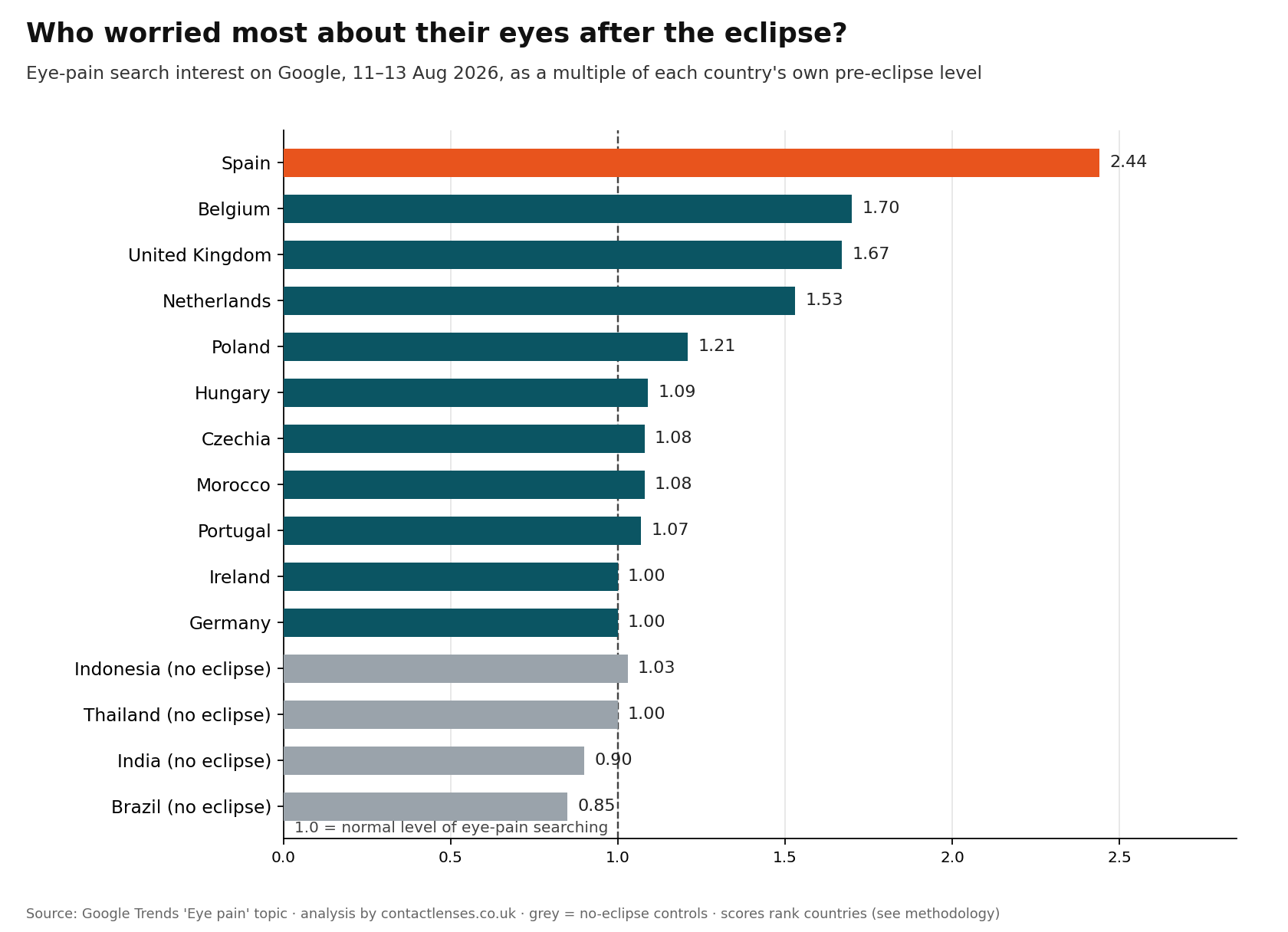
Spain saw the real thing. The band of totality crossed the north of the country, Madrid got 99.9%, and the country has been preparing for this for years, because Wednesday was the first of three Spanish eclipses in three years. None of that stopped Spanish eye pain searching climbing to roughly two and a half times its normal level across eclipse day and the day after, the biggest rise anywhere in Europe. It was not just searching, either. Spanish hospitals reported more than 300 eclipse related eye consultations in the days that followed, most of them mild.
Britain and Belgium are joint second, both running about two thirds above their usual level with the Netherlands just behind. Poland, Hungary, Czechia and Portugal registered small rises.
And then there's Ireland which had a deeper eclipse than London and showed essentially no rise. Either the Irish are Europe's most sensible sun watchers or it was cloudy over Dublin at ten past seven. We are looking into it.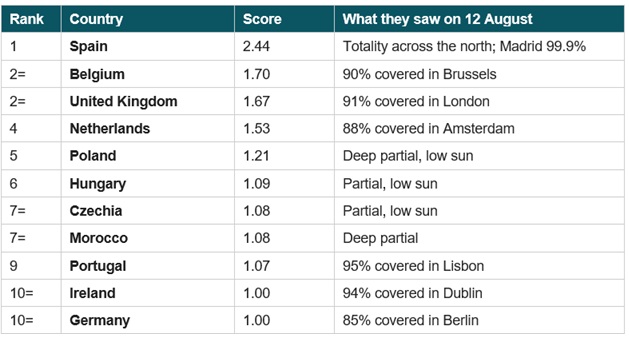 >
>
Scores show each country's eye-pain search interest during 11 to 13 August as a multiple of its own pre eclipse level. 1.00 means no change. Countries with too little search data to measure reliably are excluded. The full list and the checks we ran are in the methodology below.
Why we didn't just count searches
The obvious way to build this table would be to rank countries by how much they searched for eye pain on the night. But that is wrong and here is why.
Poland tops the raw table. But Poland tops that table most weeks because some countries simply search about eye pain more than others, eclipse or no eclipse. Thailand, which saw nothing on Wednesday, out scores every European country on raw numbers. So we compared each country with itself instead... its share of eye pain searching during the eclipse window against a normal period. Countries that never saw the eclipse land almost exactly at 1 on this measure which is how we know it works. Poland falls from first to fifth and Spain rises to the top.
The rerun is already booked
On 2 August 2027 the moon does this again and it will be an even bigger event. Totality crosses southern Spain and North Africa, lasting over six minutes near Luxor, the longest anyone on land will see this century. Most of Europe, Britain included, gets another deep partial. We will run this analysis again the day after and find out whether anyone learned anything. Our prediction is that the same countries top the table.
Methodology
Data: Google Trends, 'Eye pain' topic, interest by country, worldwide. Topic rather than search term was used to group terms in different languages ('me duelen los ojos', 'Augenschmerzen', 'ból oczu', etc.
Windows: eclipse period 11 - 13 August 2026 and the baseline period 4 - 6 August 2026.
Score: each country's eclipse window search share was divided by its baseline share. Because Trends measures share of a country's own total searching, every country is only ever compared with itself, which strips out both national search habits and how well the topic captures each language.
Obscuration figures: Unistellar's city guide, cross checked against the Royal Observatory Greenwich.